
A polar vortex
Recent cold weather in the USA

[Firstly, a warm welcome to new subscribers who have been recommended by the political economist Ann Pettifor. In return, may I also recommend her Substack ‘System Change’ to students of global economics. Ann provides a welcome perspective of current global economic issues that challenges the established way of thinking, including an insight into the corruption that pervades the current international economic and political systems.
I have just returned from a few days with family in Edinburgh, where the weather was dreich (look it up). Many of you will be aware of the lengthy period of bitterly cold weather that affected the USA in late January. For example, you may have noticed the bad weather in the television coverage of the tragic events in Minneapolis. The cold weather was caused by a southward moving polar vortex.]
January 2026
In late January 2026 a winter storm affected numerous US states with snow and ice, with unusually low temperatures which covered large swathes of the country east of the Rockies. The cold spell was notable for its severity, longevity, and geographic scope.
In the satellite images below, dark blue areas indicate the lowest surface air temperatures.
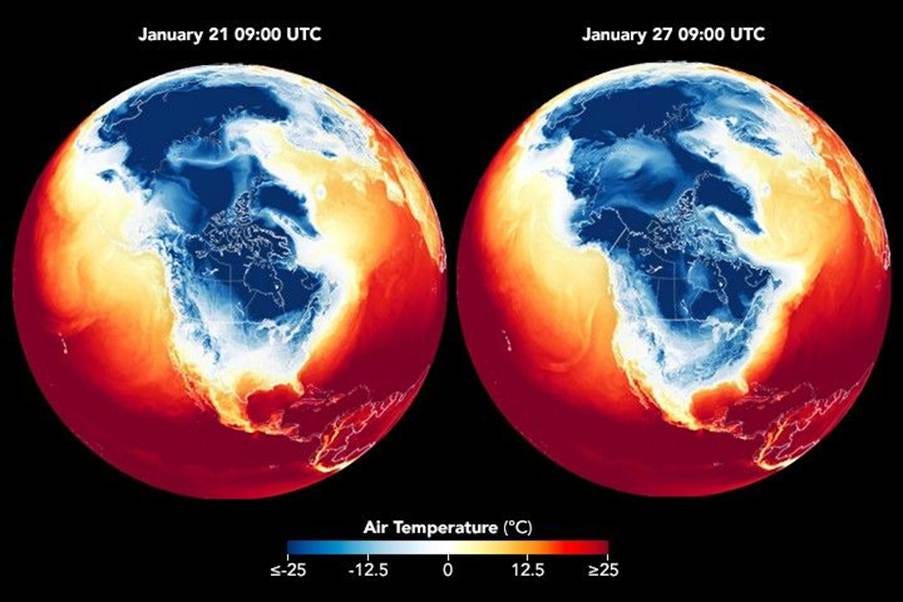
Source: NASA
According to the National Weather Service (NWS), a surge of Arctic air pushed south deep into the USA on January 22, bringing a period of low temperatures and harsh wind chills. The plunging cold collided with high levels of atmospheric moisture sucked in from the Gulf of Mexico to produce significant accumulations of snow and ice spanning from the American Southwest to New England.
In the days after the storm, dangerously cold weather persisted. In the Midwest, for example, the temperature in Alliance, Nebraska, dropped to -32C on January 24, the lowest daily minimum temperature for that date on record. In the South, extreme cold weather was experienced in southern Texas overnight on January 26, with temperatures dipping into the single digits. By January 27, parts of the South had started to see slight warming, but wind chills down to -29C continued across the Midwest and Northeast. Hundreds of thousands of people lost power across the South as ice pulled down tree branches and power lines, half a metre of snow fell in parts of the Midwest and Northeast,
The cold weather was caused by very cold air from the Canadian and Siberian Arctic, the polar vortex, funnelling into eastern North America, then being driven south as Arctic low-pressure systems forced the upper atmosphere jet stream to move southwards.
The extreme cold posed challenges for the hundreds of thousands of people who remained without power or heat after the storm and for those working to clear streets and restore power and transport services.
What is a polar vortex?
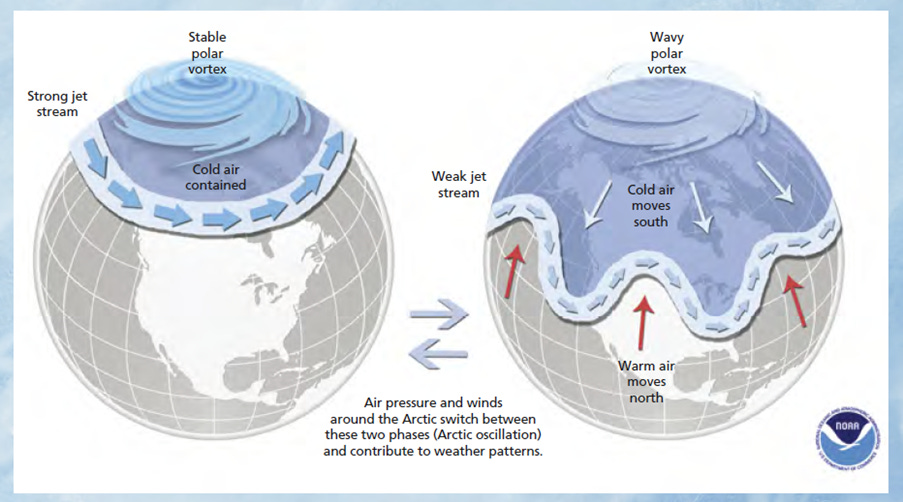
The polar vortex is important in the weather systems of both planetary poles. ‘Vortex’ refers to the counterclockwise flow around each pole that normally keeps the coldest air in the high latitudes. It is a planetary-scale circulation, in the high- to mid-latitudes, of low pressure and very cold air, bounded by a strong jet stream. In the northern hemisphere it is centred on the north pole and is called the Arctic polar vortex.
The vortex operates in all seasons but is strongest during winter when least solar energy is received and the air within the polar vortex is coldest. The thermal contrast between equator and pole is at its maximum in winter. The polar jet stream prevents the movement of cold air masses, isolating the cold air and keeping it over the Arctic. The vortex weakens in spring as sunlight returns to the polar areas and decreases the temperature gradient between equator and pole (Figure 1). When the polar vortex is stable for much of the Arctic winter, it can lead to more extensive sea ice in the Arctic Ocean.
Figure 1. Strong polar vortex (left); weaker polar vortex (right)
Two polar vortices?
The term polar vortex can refer to two different circulations, one in the lower troposphere and one in the higher stratosphere. The Northern Hemisphere stratospheric polar vortex is a belt of fast-moving air circulating around the North Pole. It is like a second jet stream, high above the one you may be familiar with from our weather forecasts here in the UK.
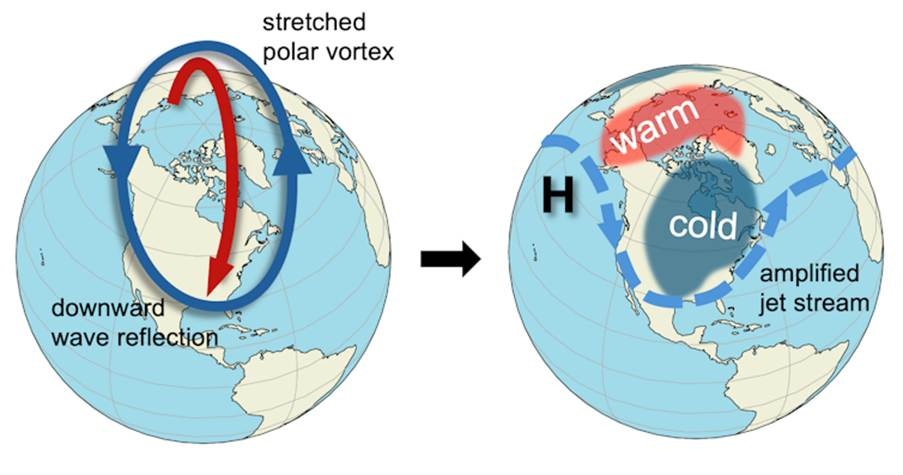
Sometimes the stratospheric polar vortex can stretch southward over the United States. When that happens, it creates ideal conditions for the up-and-down movement of tropospheric waves that connect the stratosphere with severe cold winter weather at the surface. This is what happened in late January 2026 in the central and eastern U.S.
Figure 2. Stretched stratospheric polar vortex (left); Impact of this at lower levels – troposphere (right)
Bomb cyclones
The term ‘bomb cyclone’ is used to describe the extreme drop in atmospheric pressure and intense winter conditions associated with a southward-shifting Arctic air mass colliding with a warmer air mass. Technically ‘a bomb’ occurs when a storm deepens 24 mb in 24 hours, though this is assumed to be at latitude 60N.
In late January 2026, a ‘bomb’ cyclone affected the east coast of the USA from South Carolina to New England, much of this area being well south of 60N. In fact, just off the coast of the Carolinas, air pressure deepened 27 mb in 24 hours. Snow up to a foot deep fell in South Carolina, and temperatures in several Florida cities hit record lows. It was reported that it was so cold that some iguanas here lost muscle control and fell from trees.
What is the link to climate change?
The planet is warming as human activities release greenhouse gas emissions that trap heat in the atmosphere, and amounts of snow are decreasing overall. Research suggests that even in a warming environment, cold events, while occurring less frequently, will remain relatively severe in some locations.
One factor may be increasing disruptions to the stratospheric polar vortex, which appear to be linked to the rapid warming of the Arctic associated with climate change (see right hand side of Figure 2). A warmer environment also increases the likelihood that precipitation that would have fallen as snow in previous winters may now be more likely to fall as sleet and freezing rain.
Finally, a worrying link to politics
Scientists are constantly improving their ability to predict and respond to these severe weather events, but research needs to continue. Much of the data and research in this field relies on work by American federal employees, including government labs like the National Centre for Atmospheric Research (NCAR) in Colorado, which has been targeted by the Trump administration for cuts to funding. These scientists help develop crucial models, and measure instruments and collect data that scientists and forecasters around the world depend upon.
You can find an animation of the recent polar vortex here:
Extreme January Cold - NASA Science
Also, subscribers to the excellent Substack of Alan Gerard will be able to get more detail of the weather conditions that resulted.