
Indonesian cities
World cities

[The second half of my previous post referred to US TV drama programmes representing a society underpinning them that is ‘unpleasant, morally corrupt, and dare I say, dysfunctional’. The events of the last few days have provided more evidence of this view.
If you haven’t seen the recent Substack by Hannah Ritchie (By the numbers) providing five charts that give context to Venezuelan oil, then you can read it here. Students of the AQA option Resource security, and all students of geopolitics, are recommended to read it.
Ritchie Cunningham’s Substack has developed Hannah’s piece further here.]
Jakarta
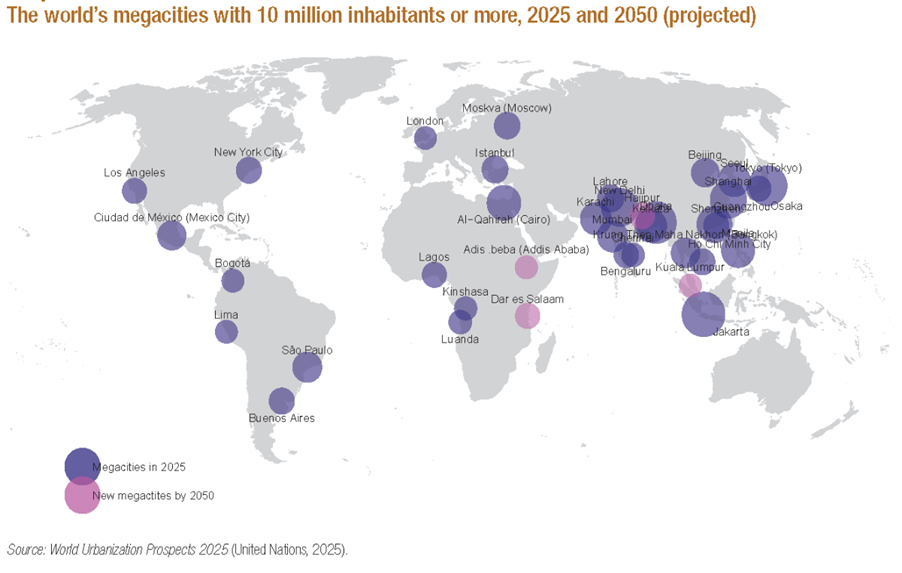
A 2025 United Nations (UN) report states that Jakarta, Indonesia, is now the world’s most populous city. Jakarta’s population has been recounted at nearly 42 million people after the UN adopted a new method that treats the capital and its dense suburbs (part of a city’s metropolitan area) as one ‘contiguous’ city, taking it past Dhaka and Tokyo in global rankings.
This comes at a time when the Indonesian government is building a new capital, Nusantara, on the island of Borneo to escape Jakarta’s flooding, pollution, and overcrowding (see below).
Overall, the report lists 33 megacities with over 10 million inhabitants today, up from just eight in 1975, and 19 of the top 33 are in Asia. The UN estimates that about 45% of the planet’s 8.2 billion people now live in cities, double the share in 1950, and by 2050 there could be more than 15,000 such cities.
Nusantara
In 2019, Indonesia’s president announced that the administrative centre of the country would move from the populous island of Java to the sparsely populated island of Borneo. Construction on the new capital city, called Nusantara - a Javanese term meaning ‘outer islands or archipelago’ - began in July 2022 in an area of forests and oil palm plantations 30km inland from the Makassar Strait.
Since 2022 the rainforest of eastern Borneo has undergone rapid change. Roads have been carved into the landscape and buildings erected near Balikpapan Bay in Eastern Kalimantan, as Indonesia builds this new capital city (see below).
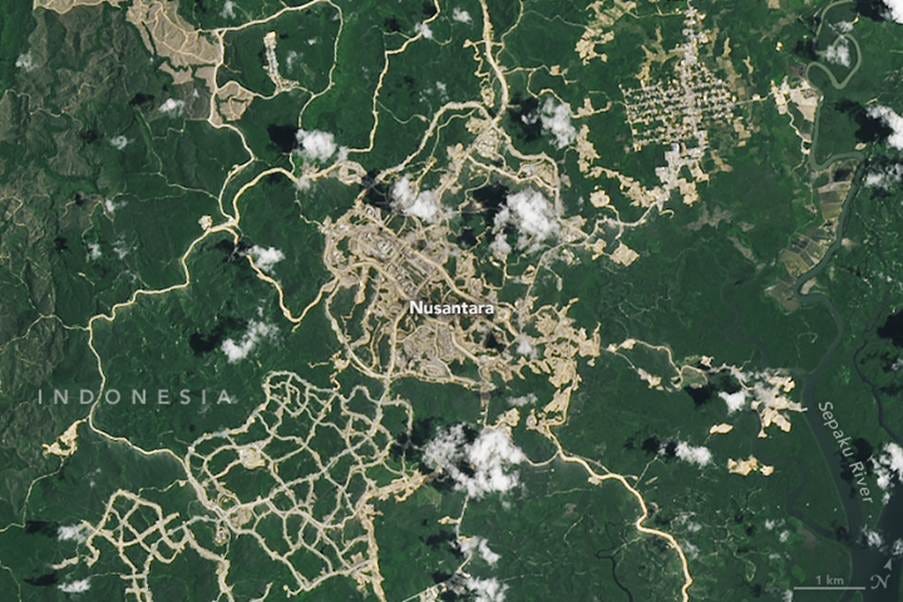
Source: NASA
Development of the new capital on the island of Borneo is driven by the number of environmental challenges faced by Jakarta, Indonesia’s current capital. The city’s metropolitan area has expanded considerably in recent decades. Frequent flooding, heavy traffic, hazardous air pollution, and drinking water shortages are common occurrences. Jakarta is also quickly sinking. Excessive groundwater withdrawals have contributed to subsidence rates of up to 15cm per year, and 40% of the city is now below sea level.
Plans state that Nusantara will be a green, walkable metropolis, powered with renewable energy, with 75% of the city remaining forested. However, some worry this land use change could harm the forests and wildlife in the region. The stretch of land and coastal waters being developed are rich in biodiversity and home to mangroves, proboscis monkeys, and Irrawaddy dolphins.
Construction is planned to be completed by 2045.
In fact, Nusantara city in Kalimantan island is failed project that made by Indonesian Government.