
Krill, Baby, Krill
Antarctica, and Food supplies

[There is a cohort of subscribers in New South Wales, Australia. Yesterday, I was in this Place - Row A, Headingley, Leeds - for the 3rd Ashes Rugby League Test of England (on the left) v. Australia (on the right). No worries mates – your boys were much better than ours.

If you go back up the stand, through the concourse, you then encounter this glorious view:
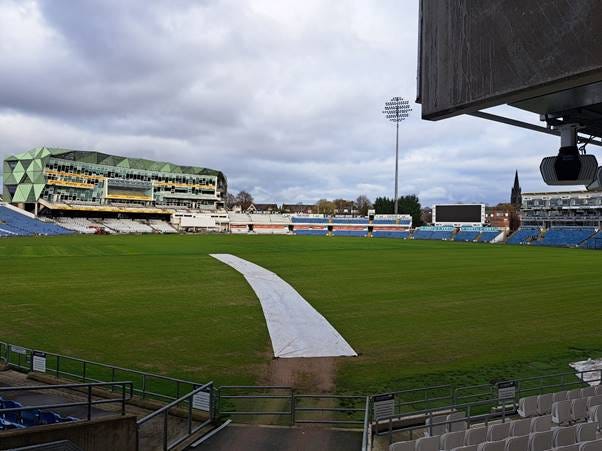
For the uninitiated, it is Headingley cricket ground (wintering) – the scene of many a notable victory over the Aussies. The Ashes proper (for North American subscribers, that means cricket) begin shortly in Perth – I can’t wait!
Staying in the southern hemisphere…. ]
Background
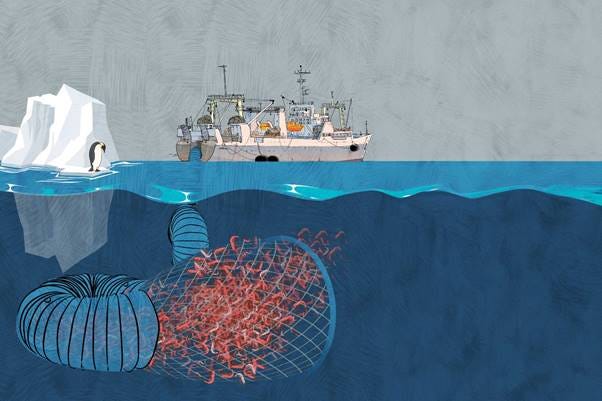
Fishing has become the main economic use of the seas around Antarctica where rock cod and krill stocks are fished by Norwegian, Russian and Japanese fishing fleets using large industrial scale trawlers.
From the 1980s to the present-day fishing for krill has become dominant in terms of the biomass of living resources exploited. However, small but biologically important fisheries for some other fish, such as the toothfish, still exist.
All these fisheries are regulated through the Convention for the Conservation of Antarctic Marine Living Resources (CCAMLR) which came into existence in 1982. A central objective of Antarctic marine research is to provide scientific support for the work of CCAMLR. It is suggested that the place of krill in the ecology of the area is crucial - if the krill disappear then the whole of the food web will collapse [Figure 1].
Figure 1. An Antarctic food web

‘Krill, Baby, Krill’
‘Krill, Baby, Krill’ is a critical investigative report produced by the Changing Markets Foundation* exposing the environmental and corporate impacts of krill fishing in Antarctica. It highlights how commercial exploitation of krill threatens the delicate balance of the Southern Ocean ecosystem. You can read it in full here:
Krill, Baby, Krill: The corporations profiting from plundering Antarctica • Changing Markets
[* The Changing Markets Foundation was formed to accelerate and scale up solutions to sustainability challenges by leveraging the power of markets.]
As illustrated above, Antarctic krill is integral to the entire Antarctic ecosystem. Much of the marine life in the Southern Ocean is either a direct predator of krill or just one step removed, meaning that many animals – including whales, penguins, seals and squid – are dependent on krill as a crucial food source.
Due to climate change, the Southern Ocean is experiencing important changes affecting temperature, sea-ice dynamics and currents, and their cumulative impact on the marine ecosystem is predicted to increase considerably during the present century. The 2022 Intergovernmental Panel for Climate Change (IPCC) report found that such changes to the west of the Antarctic Peninsula are already altering supplies of krill. It questioned the viability of supply chains and advised industry players to explore alternatives, such as microalgae.
Several studies have demonstrated how krill-fishing activities are exacerbating existing threats towards krill and the predators that feed on them. Conservationists have been ringing the alarm bell for years about how fishing activities are concentrated in very small areas. This concentration of krill fishing overlaps with foraging areas for other species, such as penguins and seals, who then must compete with fishing vessels for food.
Only five countries (a total of about 20 vessels at any one time) are involved in krill fishing in the region, with the Norwegian company and market leader Aker BioMarine taking 65% of the catch in 2021. However, catch levels have increased over the past decade, and authorised catch limits in some areas have been reached much quicker in the past few years. Meanwhile, CCAMLR has repeatedly failed to reach a consensus on more protective measures for krill and local ecosystems.
Krill-based products
Two main krill-based end products are now dominating the market: krill meal (largely used as feed additives in the aquaculture industry) and krill oil (extracted mostly to produce Omega-3 dietary supplements). Changing Markets’ survey of the 50 largest retailers’ online stores shows how widely krill-based health supplements are available around the world. Globally, of the 50 largest retailers that sell health supplements:
· 68% (34 retailers) were found to sell krill-oil products
· 88% of the 17 North American retailers and 75% of the 8 Asian retailers included sell krill-oil supplements
· Nearly half of the 21 European retail chains included sell krill-oil health supplements.
Krill meal is much harder to trace than krill oil; it is mostly used as one of ingredients of fish meal in aquaculture, for example salmon farming, an industry that, according to Changing Markets, suffers from an endemic lack of transparency. However, an investigation of a sample of 16 European retail chains in France, Germany, Spain and the UK revealed that all of them are likely to sell salmon products that were reared on feed containing krill:
· Salmon products in Aldi Nord, Edeka, Kaufland and Lidl (Germany); Auchan, Carrefour, Intermarché and Leclerc (France); Carrefour, Dia, Lidl and Mercadona (Spain); and Asda, Marks & Spencer, Sainsbury’s and Tesco (UK) were found to have links to krill meal
· The investigation also found that five of the largest European companies farming salmon (Bakkafrost, Cermaq, Grieg Seafood, Lerøy Seafood and Norway Royal Salmon) use krill meal
However, the world’s largest salmon company, Mowi (based in Bergen, Norway), appear not to be using krill-based feed. You can visit the Mowi website here.