
The Caspian Sea
A new area of geopolitical and economic importance … and musings on the World Cup

[The World Cup begins this week in Mexico, Canada and the USA. I have never been less enthused about it.
When I was a teenager, I lived in Sunderland, and in 1966 my dad took me to two games staged at Roker Park in the town. I saw the national teams of Italy, Chile and Russia (labelled USSR). I have two memories of the matches – one was of an Italian fan who gave me a key ring with the Italian flag on it (which I kept for many years) and the other of seeing the Russian goalkeeper, Lev Yashin, as I stood (note – stood) in the Roker End. He seemed an enormous man – dressed in a black kit (do goalkeepers wear black these days?).
So, to 2026…. too many matches, hugely inflated seat/hotel/transport prices, ICE at stadiums, the crass ignorance of Trump, Vance and Hegseth, a stadium ban of hard resealable water bottles, half-time American-style entertainment (really!!), visa and social media checks, the horrendous carbon footprint, and, due to time differences, overnight games on the television.

But I will watch some of it. I have my Radio Times World Cup wall chart opened out in my home office; I have a 6-year-old Edinburgh-living granddaughter who loves to play ‘fitbaw’; and I have national pride and want to see England (and Scotland) do well.
What are the odds of an England/Scotland penalty shoot-out with Germany?]
Introduction
The Caspian Sea hosts major offshore oil and gas fields and critical maritime infrastructure, including ports, pipelines and terminals that connect the myriad of states in central Asia to global markets. It provides a ‘middle corridor’ east-west trading route from China to Europe via central Asia that avoids increasingly uncertain routes via Russia to the north and Iran to the south. It also provides a north-south route between Russia and Iran (Figure 1).
Figure 1. The Black Sea/Caspian Sea region
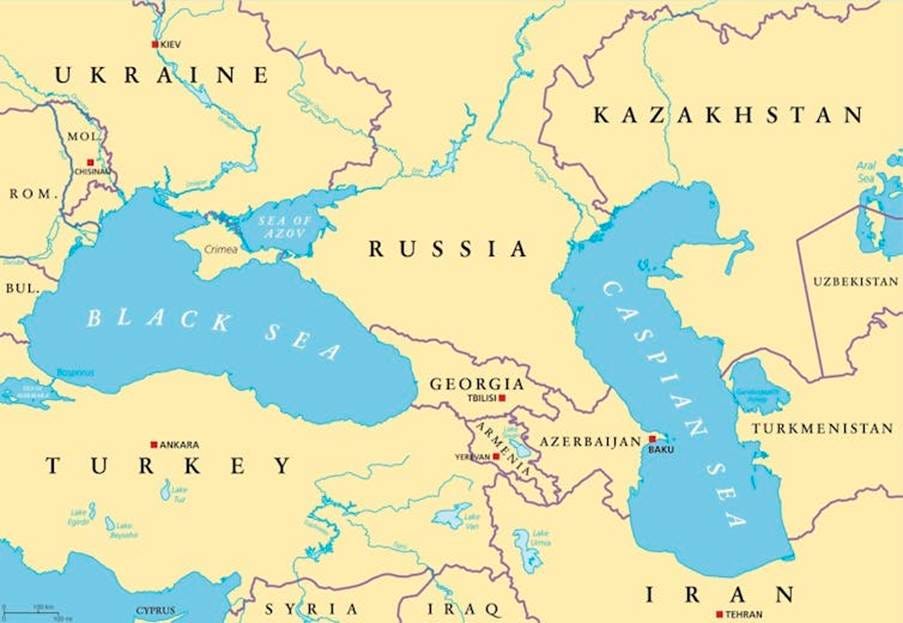
China views the Caspian as a key corridor for energy supplies and its ‘Belt and Road’ initiative that is an economic strategy that intends to expand Beijing’s influence. This middle corridor links mainland China to Europe via Kazakhstan and Azerbaijan. Turkey also uses Caspian Sea links, especially fossil fuel transit projects, via Azerbaijan, to increase its influence across the Turkic world.
The 2018 Convention on the Legal Status of the Caspian Sea sets out how the Caspian’s oil, gas, and fishing resources are divided among the nations that border the sea. The agreement also prohibits the deployment of armed forces from third-party countries within the Caspian’s waters. This also establishes a regional security order that excludes western military presence.
The importance for Russia
For Russia, the Caspian Sea has a high value, currently as a bridge to Iran. Moscow maintains the strongest navy in the sea and has used the Caspian as a platform for its power projection. Since Russia’s full-scale invasion of Ukraine in 2022, the Caspian Sea has also gained importance as a maritime space for Moscow. Elements of the Black Sea Fleet, increasingly under threat from Ukraine’s drones and missiles, have redeployed away from the contested Black Sea towards the Caspian Sea via a series of inland waterways. Despite this, Ukraine has recently attacked the fleet here too.
The Russia/Iran connection
The Caspian Sea plays a significant role in enabling coordination between Russia and Iran. It provides a direct logistical and economic corridor between the two states that is largely shielded from western military presence and interruption.
The Caspian corridor enables not only energy cooperation and trade flows but also the movement of technologies and materials relevant to sustaining both economies under war-related sanctions. This includes sanctioned goods, drone components and mutual technologies.
The current US/Israel/Iran war has accelerated the importance of these trading links. Israeli airstrikes have reportedly disabled dozens of Iranian Caspian naval assets, including missile boats, a corvette, a shipyard and a command centre. The strikes will have severely disrupted the Caspian corridor that links Russian ports to Iran’s port at Bandar Anzali, the largest Iranian port on the Caspian Sea. This could force both countries to rely more on riskier overland routes via Azerbaijan or Kazakhstan (see Figure 1).
Conclusion
The Caspian Sea has become an increasingly important strategic corridor linking two major conflicts. The wars in Ukraine and the war in Iran are not separate, but parts of a Eurasian conflict in which Russia and Iran are mutually dependent.
Iran’s provision of drones and other military support to Russia has directly affected the course of the war in Ukraine. Meanwhile, Russia’s diplomatic, military and economic backing is key to Iran’s capacity to withstand pressure and sustain its economy. The Caspian Sea underpins this alignment by providing a relatively insulated corridor for logistics, economic and military exchange.
At the same time, other countries, notably China and Turkey, are investing in the east-west ‘middle corridor’. All of these movements are increasing the importance of the Caspian Sea, both economically and in terms of its geographical connectivity.
Sorry for 'treading on your toes'. We tend to complement each other, yet sometimes have a different focus. All good for our subscribers!
Excellent as always, I was going to do a post on the Caspian Sea over the summer as well, but I'll leave it for a while.