
The enlightened industrialists
Saltaire and David Hockney

[Last Friday the death of a great Yorkshireman, the artist David Hockney, was announced. Hockney was born in Bradford, West Yorkshire, was educated at Bradford Grammar School, and often came home to Yorkshire, though spent much of his life in California and France.
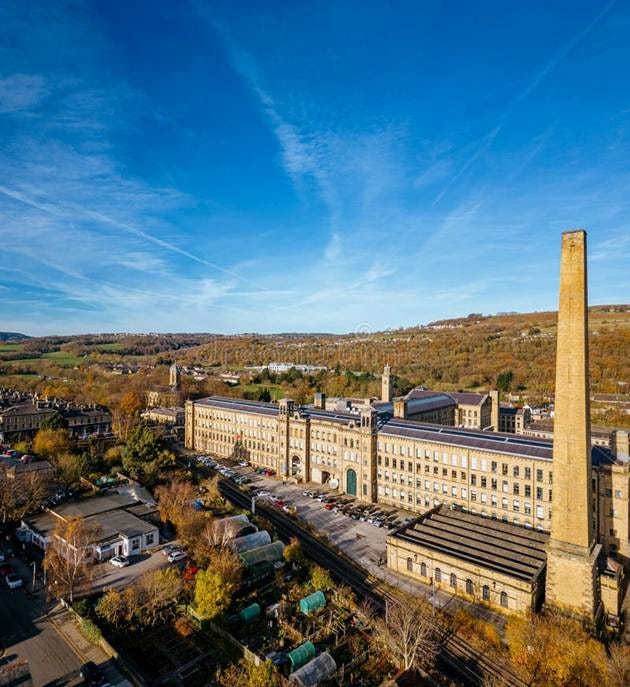
Just over the hill in West Yorkshire, in the Aire Valley, is the small town of Saltaire, containing Salts Mill. Salts Mill is set in the UNESCO World Heritage Site that is Saltaire. The Grade II Listed historic mill building (see photo at end) was built in 1853 by Sir Titus Salt along with the village to house his workers. The whole area is of architectural and historical interest. Salts Mill is now home to one of the largest collections of David Hockney’s art.]
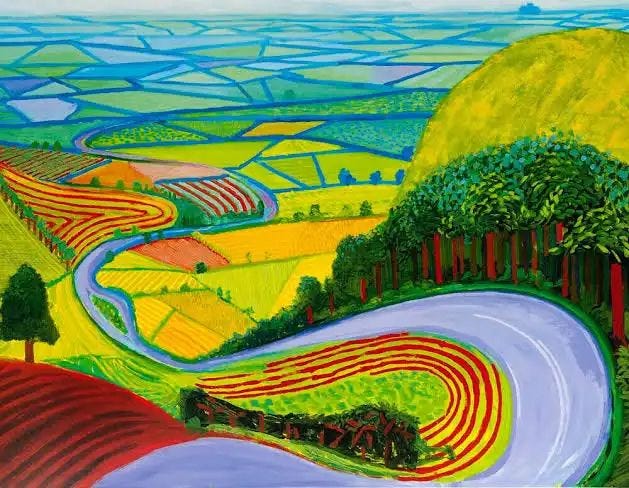
Garrowby Hill, by Hockney – a classic Yorkshire view
Enlightened industrialist
An ‘enlightened industrialist’ was a 19th century factory or mill owner who was determined to provide better quality housing and other social services for the workforce and their families. Enlightened industrialists were appalled at the poor-quality living conditions faced by the ordinary people in industrial towns. They witnessed several cholera outbreaks in the mid-19th century, which killed thousands of people.
In some cases, as in the Cadbury brothers and Joseph Rowntree, they were influenced by religion. These were Quakers and were against the widespread use of alcohol by people to make themselves feel happier and hide the problems of life in those times. They were determined to provide better housing and better social values within the area served by their factories. Purpose built settlements were constructed close to factories and mills, with specially designed housing and services. Many of the settlements are described as being “utopian”. [The concept of Utopia was viewed by many at the time as being an imaginary island with a perfect social and political system.]
Examples of enlightened industrialists and their settlements in the UK are:
the Cadbury brothers at Bournville, Birmingham
David Dale/Robert Owen at New Lanark, Scotland
William Hesketh Lever at Port Sunlight, Wirral
Sir Titus Salt at Saltaire, near Bradford.
Saltaire
Saltaire consists of a model industrial village and former textile mill north of Bradford, built by the industrialist Sir Titus Salt. The village is a perfectly preserved 25-acre site of one man’s Utopia. Having built his fortune on the use of alpaca and mohair, Salt found that by the late 1840’s his former mill in the city of Bradford was too small to meet the demands of his new textiles. In addition, in 1849 a major cholera epidemic struck Bradford. Being a strict Congregational Christian, he stated that “Cholera was God’s voice to the people”, and so he decided to build a better community for his workers.
Saltaire was built between 1852 and 1872 and was modelled on the buildings of the Italian Renaissance period - a period (in Salt’s opinion) when both cultural and social advancement took place. Salt’s mill emulated an Italian Palazzo, was larger than St Paul’s Cathedral, and was the largest factory in the world when it opened. It was built alongside the Leeds Liverpool canal, which allowed easy access of raw materials. It was surrounded by a school, a hospital, a railway station, parks, baths, washhouses, 45 alms-houses, and 850 houses. The style and size of each house reflected the place of the head of the family in the factory hierarchy. Twenty-two streets were created, and all but two (Victoria and Albert Streets) were named after members of Salt’s family. The church was the first public building to be completed, and there was not a single public house.
Today, the mill is now converted into a variety of uses. Parts of it are used by a micro-electronics company, whereas others are used as an art gallery for the works of David Hockney, and as a designer shopping area. The village is still well maintained with a parade of shops and a small-scale tourist industry.
Salts Mill, Saltaire
And finally, for subscribers in the USA, a little bit of place-identity …
I also regard this Substack as being enlightening. Sometimes I feel I must achieve this aim for the few hundred people who subscribe and reside in the USA. Many of you will be aware of one Brian Kilmeade, a Fox News host, who stated in a conversation with Markwayne Mullin (the current US Secretary of Homeland Security) last week, regarding the recent unrest across Northern Ireland in the aftermath of a dreadful knife attack in Belfast, of the rioters who forced some migrants and others to leave their homes: ‘all they want to be is Irish They want Ireland back.’
A few points: Belfast is in the UK; this incident has got nothing to do with the unification of Ireland, which incidentally is a different country. The rioters were Loyalist Protestant people – they want to be part of the UK. They would be outraged to be described as Irish. The ignorance, the stupidity, of both Kilmeade and Mullin is mind-boggling.
Mr Kilmeade also said in the broadcast that he had not been to Belfast. I walked down the Shankill Road, Belfast, a loyalist area, in the autumn of 2022. It’s a fascinating experience – if Mr Kilmeade was to visit Belfast, I suggest he has a wander down that road too. He might learn something.
One would suggest that Mr Kilmeade keeps it buttoned until he has visited Belfast and spoken to some people om the ground as it were!