Two major infrastructure projects
Including trans-boundary issues

[A couple of points first…
Firstly, many of you will have seen the dreadful floods that have taken place in southern and southeastern Asia. For an insight into the causes of these floods, together with an explanation as to how these events link into ENSO, then the US meteorologist Alan Gerard’s recent Substack is a useful read here.
Secondly, as we enter December, a time full of tradition, many young people around the world will be nervously awaiting missives through the post and/or email, before having to meet a stranger in a darkened room (in person or via Zoom/Teams etc). I am, of course, referring to the Oxbridge interviews. Here is the piece I wrote on the topic last year: Oxbridge interviews - by David Redfern. ]
The Motuo mega-dam, China
China has started building what could become the world’s largest HEP installation: a $150 billion mega-dam complex on the Yarlung Tsangpo River in Tibet’s Nyingchi region - just 30km from its disputed border with India (see map below). The river, known as the Brahmaputra in India and the Jamuna in Bangladesh, is one of Asia’s most important trans-boundary waterways.
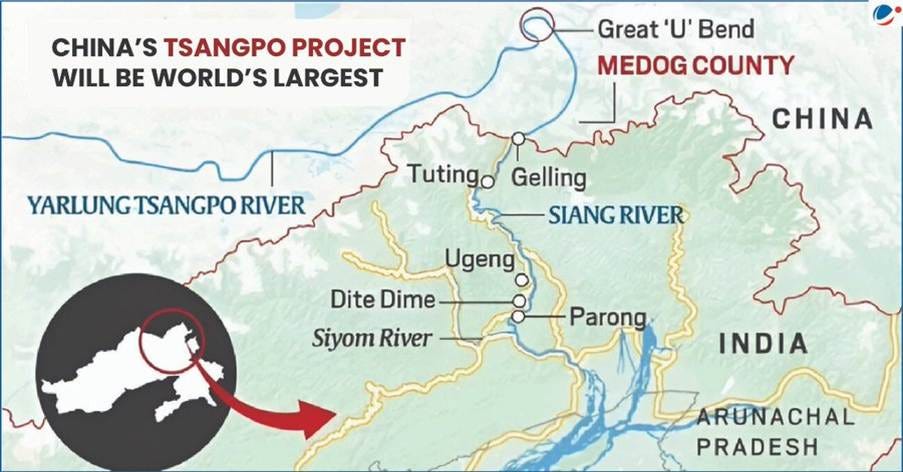
This mega-dam project, promoted by Chinese state media as a pillar of ‘green development’ and regional uplift, is poised to become a fault line in Asia’s fragile geopolitical environment. With five HEP stations planned along the upper reaches of the river, the Motuo HEP project aims to generate a staggering 300 terawatt-hours annually - more than the entire electricity consumption of the UK.
When completed it will eclipse China’s own Three Gorges Dam and become the largest hydroelectric source in the world. The dam is part of China’s dual agenda: reaching carbon neutrality by 2060 and stimulating domestic demand through mega infrastructure. The Yarlung Tsangpo, winding through the Tibetan Plateau at over 5,000m above sea level, is not merely a hydrological asset. It is a sacred river for Tibetans and a lifeline for hundreds of millions downstream. The region’s glaciers and watersheds feed ten major Asian rivers that support nearly 1.3 billion people across ten countries. Tibet’s cultural and religious leadership, including advocates of the Dalai Lama’s “Middle Way” approach for meaningful autonomy, have repeatedly warned that large-scale industrial projects risk violating the spiritual and environmental fabric of the plateau.
The project will involve tunnelling through the Namcha Barwa mountain – also considered sacred - while altering river flows in a topographically unstable region prone to landslides, glacial lake outbursts, and tectonic activity.
The Yarlung Tsangpo/Brahmaputra/Jamuna basin contains an estimated 400 million people who rely on the basin for drinking water, agriculture, fisheries, energy, and transportation. Any disruption or manipulation of flows upstream - accidental or deliberate - would have cascading consequences downstream. India has responded cautiously. New Delhi raised objections in January 2025 stating it would “monitor and take necessary measures to protect our interests.” Beijing, for its part, reiterated the project would cause “no negative impact,” and promised “communication and consultation.”
China’s Motuo mega-dam is a significant geopolitical issue. It alters the strategic balance between upstream China and downstream India and Bangladesh. It underscores Beijing’s readiness to leverage critical infrastructure for geo-economic influence, while tightening control over Tibetan territory.
More broadly, the dam exemplifies an era in global affairs, where rivers are no longer neutral - they are assets to be controlled and contested in a changing world.
See also:
By building the world’s biggest dam, China hopes to control more than just its water supply
China to build world’s largest hydropower dam in Tibet - BBC News
A new rail tunnel under the Alps
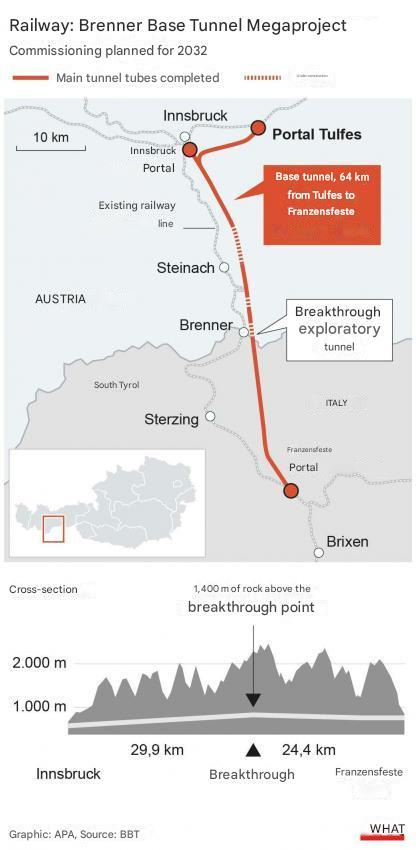
Engineers have once again broken through beneath the Alps, creating the first direct rail link between Italy and Austria and marking a major milestone for the European Union-backed Brenner Base Tunnel. The 64 km long line, including the Innsbruck bypass, is set to become the world’s longest underground railway. It will cut travel time from Fortezza, Italy, to Innsbruck, Austria, from about 80 minutes to 25 minutes and allow trains to travel at speeds up to 250 km/h. Built up to 1,400 m below the Brenner Pass, the project aims to shift traffic from road to rail on one of Europe’s busiest freight corridors.
While the remaining Brenner tunnel tubes are yet to be completed, the completion of the first tunnel overcomes a significant hurdle in the project. Costs are estimated at around €10 billion with significant EU funding, and trains are expected to run by 2032. Supporters say the line will cut pollution and boost trade, though full benefits depend on Germany completing key access routes from the northwest.