
Water usage and AI data centres
And, ‘FEMA is paralysed’

[Two short posts with a USA theme, though the first post will have a resonance with other countries, including here in the UK where the government is keen to encourage the construction of AI data centres. This is linked to Global systems.
The second post reflects an on-going situation regarding the organisation FEMA (Federal Emergency Management Agency), both before and since the shut-down of the US government that is currently taking place. FEMA is a staple for A level students of Hazard geography, as an exemplar of hazard management.]
AI data centres
A $3.3 billion Microsoft AI data centre campus, the world’s most powerful, is to open in 2026 in Mount Pleasant, Wisconsin, USA. To meet electricity demand, the state government has approved two new natural gas power plants which are expected to operate for 30 years.
Environmental groups are expressing concerns regarding the amount of energy and water these data centres will use once construction is finished. One group, Clean Wisconsin, conducted an analysis and found that the Microsoft data centre and another Vantage Data Systems data centre in the state will consume more energy than all homes in state combined. The projects require a combined total 3.9 gigawatts of power and hundreds of thousands of gallons of water for cooling maintenance. Another group, Midwest Environmental Advocates, has filed a legal injunction against the city of Racine to obtain records about the Mount Pleasant project’s water usage.
AI data centres are being constructed at a rapid rate right across the USA, as the map and the graph below show, driven by some very well-known names in IT and AI.
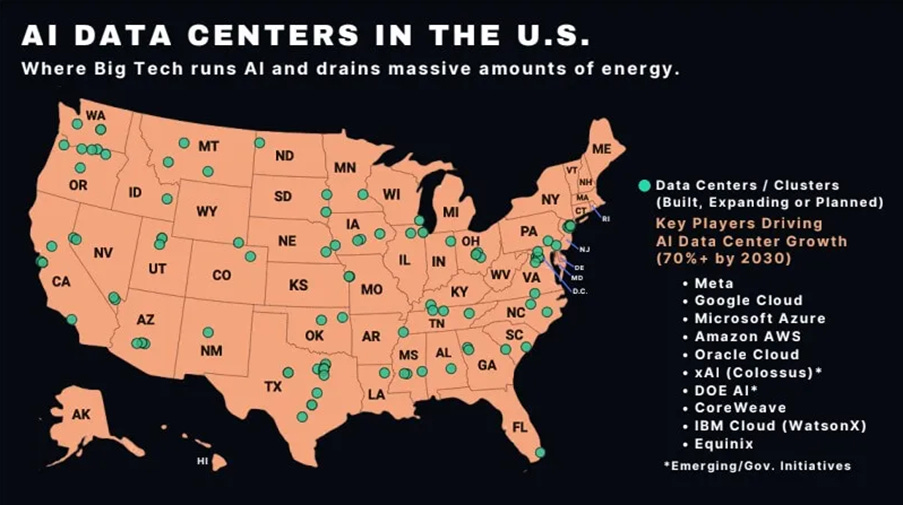
Source: Bloomberg
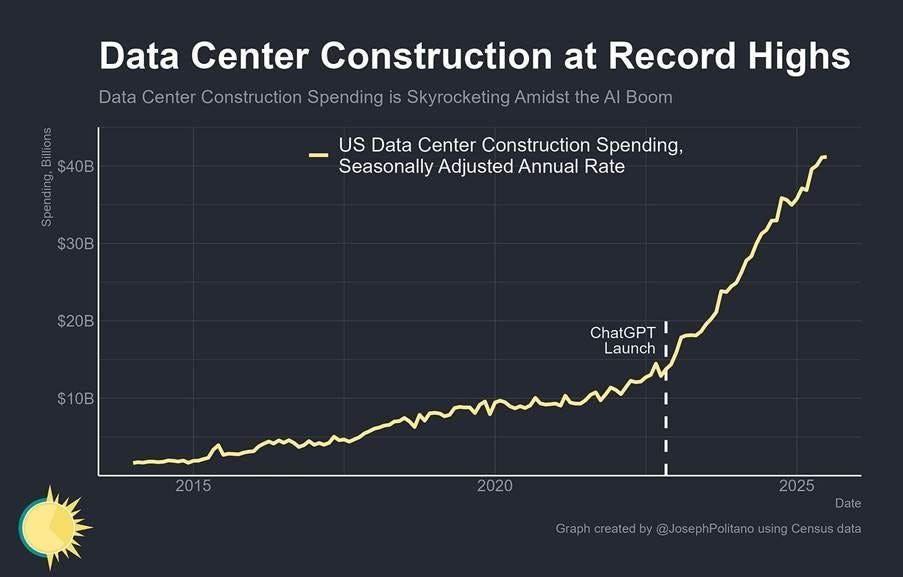
Source: Joseph Politano
Impact on water supplies
Everything we do on the internet travels through data centres. Every search we make and every email we send requires water. This amount of water doubles when AI is involved. Without urgent action, clear regulation, and genuine accountability, environmental advocates state that we will never know how much water is being used until we feel its effects.
Cloud computing is ‘drying out’ much of the world’s water resources. The average 100-megawatt data centre consumes about 2 million litres of water a day, equivalent to the water consumption of typical 6,500 Western households. Globally, data centres consume around 560 billion litres of water annually, or the equivalent of 224,000 Olympic-sized swimming pools.
Not only do they consume massive amounts of water, two-thirds of new data centres built or in development globally since 2022 are in places already plagued by water stress (Figure 1).
Figure 1
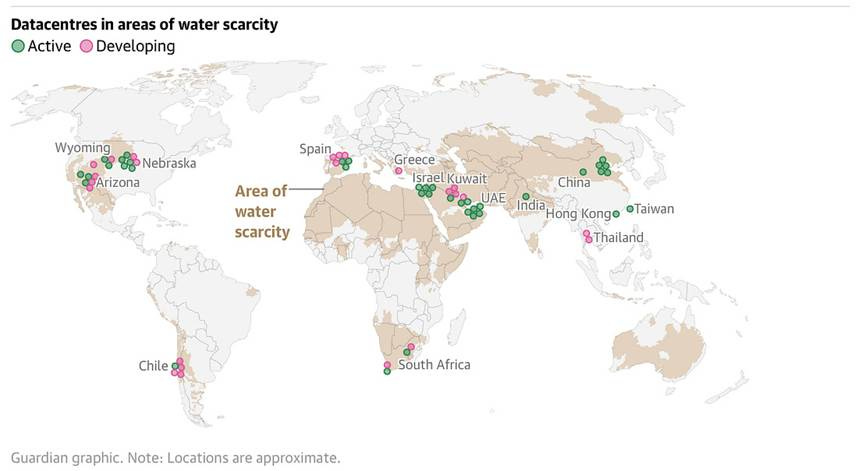
Image: The Guardian
Even before the launch of OpenAI’s ChatGPT, many communities complained about data centres using up millions of gallons of water. Data centres are physical spaces that house computing equipment, such as servers, storage systems, and network equipment. The so-called ‘cloud’ is just a collection of data centres.
To power these data centres, water is used in two ways:
indirectly, to generate the electricity
directly, to cool down servers and other equipment.
Computer equipment needs to stay cool to function properly. Continued exposure to high temperatures can cause irreversible loss of functionality. High temperatures can also cause electrical fires. Data centres in hot regions require more cooling.
As for indirect water consumption, nearly half of US data centres are fully or partially powered by power plants in water-stressed regions. The International Energy Association estimates that 60% of data centre water consumption is from indirect use. Regarding direct water consumption, data centres rank in the top 10 highest water-consuming American industrial or commercial industries.
Furthermore, most large tech companies often rent a large portion of their data centre capacity from third-party data centre operators (called ‘colocation’ data centres). Large tech companies represented over 35% of worldwide data centre capacity in 2022, with half of that being third-party contracts. By using third-party operators, tech companies can falsely claim reduced carbon footprints through reduced emissions, water use, and hence a negative climate impact.
Impact on electricity prices
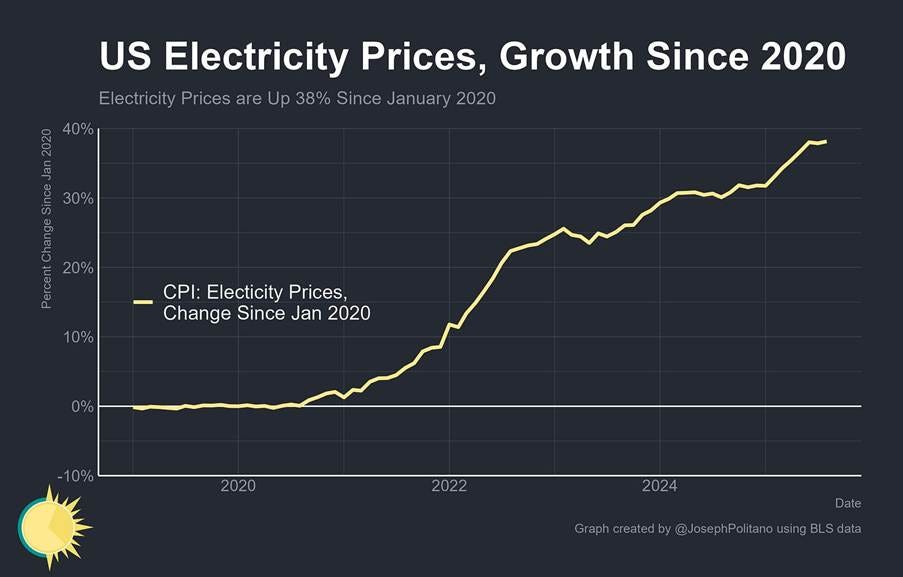
Source: Joseph Politano
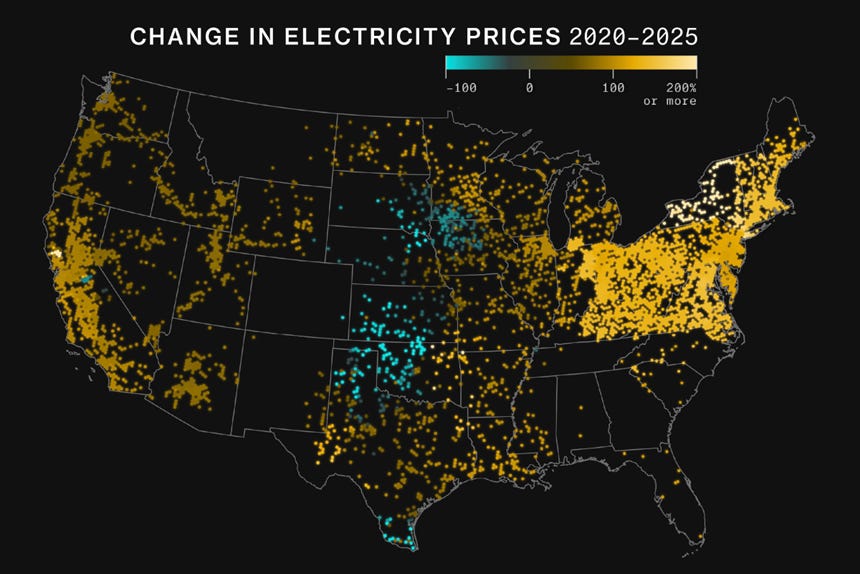
Source: Bloomberg
A review by the news organisation Bloomberg of electricity prices at thousands of locations across the U.S.A. found wholesale electricity prices are up to more than 200% more expensive than five years ago in areas near new AI data centres, and over 30% generally.
Another recent analysis from Goldman Sachs Research forecasts that about 60% of the increasing electricity demand from US data centres will be met by burning fossil fuels, thereby raising carbon emissions in the country. This is because the Trump US Energy Information Administration has cut its 2025 renewable energy growth provision.
All of this explains why US electricity prices are up more than 6% when compared to last year and are projected to rise even further.
Additional notes:
· UK electricity prices are significantly higher than those in the US, with UK households paying nearly double per kilowatt-hour.
· UK homes use higher voltage (230V) than US homes (120V), which means UK circuits can deliver more wattage for the same current. If you ever stay in a North American hotel and try to boil your travel kettle or use your hair dryer/straighteners, you will be waiting for quite a while!
FEMA
Keeping up with political events in the USA is a full-time job. The Trump administration has several views and policies which are undermining long-established norms and practices within the country, including disaster management.
A recent article in the Wall Street Journal (WSJ) summarised the concern that many people have about the future role of the Federal Emergency Management Agency (FEMA). The article is entitled ‘FEMA is paralysed’.
I am a subscriber to the Substack of Alan Gerard, a retired US meteorologist. If you want to subscribe, it is entitled Balanced Weather (search in the Substack app). Here is an extract from a recent post by Alan (in italics) about the FEMA issue (which also includes a further extract from the WSJ article):
… this Wall Street Journal investigation makes it clear that FEMA is struggling to respond to even “smaller” disasters where their help is needed. In my opinion, we should be very concerned about our national capacity to respond to the next catastrophic event we have to deal with.
The article is a devastating expose of the incredible dysfunction that has overwhelmed FEMA in the last six months, making its crucial disaster response and recovery work increasingly ineffective. The article focuses on the agency’s response to the devastating violent tornado that struck the St. Louis metropolitan area on May 16th of this year:
Extract from the WSJ:
‘St. Louis is a test case for the Trump administration’s new policy of shifting more responsibility for natural disasters to states and cities. City officials and local residents who are still clearing rubble from destroyed buildings four months after the tornado struck said the experiment isn’t going well.
Many of FEMA’s core functions related to preparing for natural disasters and leading recovery efforts after they strike have ground to a halt as the Trump administration redefines the agency, according to more than a dozen FEMA employees and local officials, as well as a review of internal government documents.
Crucial contracts and grants haven’t been approved, caught up in layers of new bureaucracy. A wave of senior staff departed the agency when Elon Musk’s Department of Government Efficiency offered buyouts, taking decades of experience with them. Around 400 FEMA employees have been detailed to work at U.S. Immigration and Customs Enforcement, as that agency rapidly expands. And the administration has started dismantling the agency’s disaster-response infrastructure, which was strengthened in the aftermath of Hurricane Katrina in 2005.
The scaled-back federal response has left places like St. Louis in a bind. The city doesn’t have the finances, institutional knowledge or equipment to rapidly respond to catastrophic disasters like the tornado that struck in May, which the city estimates caused $1.6 billion in damage.’ (WSJ)
I cannot overemphasize how incredibly concerned (and to be honest, angry) reading these paragraphs make me. If anything positive came out of (Hurricane) Katrina, the tremendous improvements to emergency management at the federal and state levels - particularly in Louisiana - in my opinion would qualify. The fact that the administration is specifically targeting those improvements for dismantling is absurd.
Furthermore, the continued messaging from the Trump Administration that they are “shifting more responsibility for natural disasters to states and cities” is patently ludicrous. To reemphasize yet again, emergency management in this country is already established legally and structurally so that the primary responsibility rests at the local level. States become involved when local communities are overwhelmed by a disaster, and feds become involved when states are overwhelmed. State emergency management agencies and FEMA provide support and coordination to the levels below them - but the primary responsibility for the four phases of emergency management (mitigation, preparedness, response and recovery) already resides at the local level.
A related point
This year has been a remarkable year (so far) when it comes to hurricanes affecting the USA. Autumn is the ‘hurricane season’ in the US, and this year, although hurricanes have formed in the Atlantic, some of them very large, not one has struck the country directly. They have been created and dissipated to the east, in the Atlantic Ocean – though Barbados has been affected by them.
If this pattern holds, it would be the first season without a storm coming ashore at hurricane strength in a decade.