
Will New Orleans disappear?

[Here’s another Substack recommendation: the new twice-monthly digest of highlights from Our World in Data – the The OWID Brief | Our World in Data | Substack
The latest edition of the above contains a summary of the recent article for the Financial Times by (fellow Bessacarr, Doncaster resident – how weird is that?) John Burn-Murdoch with his proposal why fertility rates around the world have plummeted ….. the existence of 5G (OK, it sounds like a conspiracy theory, but it’s a bit more complicated than that).]
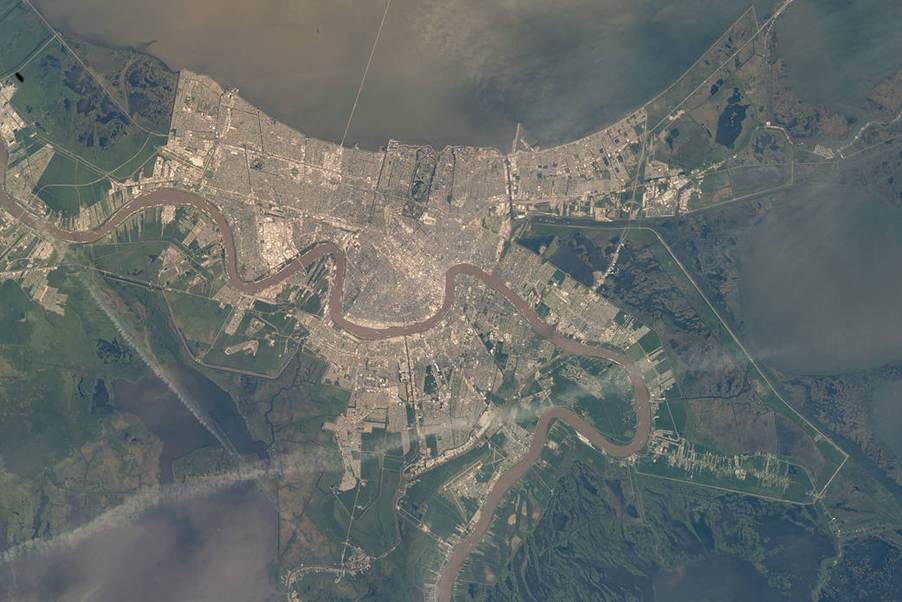
Photo: NASA (April 28, 2022) — New Orleans, Louisiana, and its surrounding suburbs, pictured along the Mississippi River with Lake Pontchartrain at the top.
Introduction
Hurricane Katrina struck the region around New Orleans in late August 2005, and the U.S. President at the time was George W. Bush, who was in his second term. Katrina’s impact was catastrophic, reshaping the U.S. Gulf Coast physically, socially, and economically. It caused over 1,300 deaths, displaced hundreds of thousands of people, mainly low‑income and African American communities, and produced over $125 billion in damage, making it one of the costliest and deadliest disasters in U.S. history.
Twenty years later, according to a new study, the city of New Orleans faces compounding, structural, and accelerating coastal‑flooding threats driven by sea‑level rise, land subsidence, wetland loss, and intensifying storms. The city is now described by these researchers as approaching a ‘point of no return’ where long‑term habitation is in question.
Core problems driving coastal flooding in New Orleans
1. Rapid sea‑level rise
Southern Louisiana is projected to face 3-7 metres of sea‑level rise, enough to push the shoreline up to 100km inland, effectively surrounding New Orleans with the Gulf of Mexico by the end of the century. This scale of rise makes the region one of the most physically vulnerable coastal zones in the world.
2. Severe wetland loss
Coastal wetlands - New Orleans’ natural storm‑surge buffer - are disappearing at extreme rates due to:
oil and gas canal dredging
river leveeing that prevents sediment replenishment
saltwater intrusion
subsidence
Researchers estimate three‑quarters of remaining wetlands may be lost, removing the city’s last natural line of defence.
3. Land subsidence
Satellite‑based studies show parts of New Orleans are sinking up to 47mm per year, including sections of the $15 billion post‑Katrina floodwalls. Some floodwalls are subsiding faster than sea levels are rising, reducing their protective height and requiring constant, expensive upgrades.
4. Stronger, wetter hurricanes
Climate change is increasing the intensity of Gulf hurricanes, which:
push higher storm surges into Lake Pontchartrain and the Mississippi River
overwhelm levees and pumps
produce extreme rainfall events
This compounds the city’s exposure, especially as protective wetlands vanish.
5. Ageing and sinking flood defences
Despite billions spent after Hurricane Katrina, the levee and floodwall system:
requires continuous elevation increases to keep pace with subsidence
is already showing structural vulnerabilities
cannot provide long‑term protection under high sea‑level‑rise scenarios
Researchers warn that levees alone cannot save the city in the long run.
6. Population and economic pressures
Louisiana is already experiencing population loss, and unmanaged climate migration could accelerate as flood risk grows. Studies argue that planned relocation may need to begin within decades to avoid chaotic displacement.
The Future
The scientific consensus emerging from recent studies is stark:
Coastal Louisiana has likely crossed a threshold where long‑term survival of New Orleans in its current form is uncertain. Even with aggressive climate mitigation, the combination of:
rising seas
sinking land
disappearing wetlands
intensifying storms
ageing defences
creates a trajectory where flood risk will continue to rise for generations.
Implications
The study states that the process of relocating people from New Orleans should start immediately, which would involve the movement to safer ground of over 350,000 people from the city. It recommends starting with the most vulnerable communities, such as those in Plaquemines parish who live outside the levee system.
New Orleans faces obvious challenges – situated in a bowl-shaped basin below sea level, the city already has 99% of its population at major risk of severe flooding, the worst exposure of any US city. A significant pressure upon the city is that its surrounding land is receding rapidly. Since the 1930s, Louisiana has lost 2,000 square miles of land to coastal erosion, with a further 3,000 square miles set to vanish over the next 50 years.
To help counter this, over the last decade Louisiana has operated a plan that aimed to build fewer flood defences and instead sought to harness the Mississippi River’s natural ability to rebuild land. Levees and other man-made infrastructure have, until now, straitjacketed the naturally meandering Mississippi and pushed the sediment it carries straight into the Gulf of Mexico, rather than replenish the coastal wetlands.
The Mid-Barataria Sediment Diversion project, which started in 2023, intended to restore a more natural flow in the Mississippi Delta and allow sediment to build up in coastal areas where it has been lost. More than 20 square miles of new land would be created over the next 50 years under the plan, the project estimated.
However, Jeff Landry, Louisiana’s Republican governor, scrapped the project in 2025, arguing its $3bn cost was too high and that it threatened the state’s fishing industry. Supporters of the project, which was funded via a settlement from BP resulting from the Deepwater Horizon disaster in 2010, decried the decision as disastrous for the state, pointing out fishing communities will need to move anyway because of worsening erosion.
And so, according to the study, the loss of the sediment diversion plan ‘effectively means giving up on extensive portions of coastal Louisiana, including the New Orleans area’.